Author: Baldwin Business

  • Asset Tracking in Retail: Preventing Loss, Gaining Insight

    Retail asset tracking and inventory verification system

    Introduction

    Retail shrink is the silent killer of margins. Every month, products disappear from shelves, stockrooms, and loading docks. Sometimes it’s theft. Sometimes it’s damage. Sometimes it’s simple miscounting. But the cumulative effect is devastating — the National Retail Federation estimates that shrink costs the retail industry billions annually, with individual stores losing 1-3% of inventory value to unexplained loss.

    Most retailers know they have a shrink problem. What they don’t know is where. A product that disappears from a downtown location might be a different issue than loss at a suburban store. Items that vanish from high-traffic areas need different solutions than products lost in back-of-house. Without visibility into where loss is happening, retailers spend money on generic security measures that don’t solve the actual problem.

    The challenge is that retail operations are sprawling. Multiple locations. Hundreds of SKUs. Constant inventory movement. Tracking which products are going missing, where, and why requires visibility across the entire system — real-time data about what’s in stock, where it’s located, and when it moves. Digital inventory systems help, but they’re only as accurate as the data fed into them. That’s where verification becomes critical.

    Modern retail loss prevention combines three data streams: digital inventory tracking (what the system says you have), mobile verification (what staff actually see on shelves), and physical asset verification (structured documentation and labels that confirm real-world inventory state). When these three sources align, you see loss. When they don’t, you find problems before shrink happens.

    In this guide, you’ll discover how retail operations layer digital tools, mobile verification, and structured asset documentation to build visibility that prevents loss at scale.


    Why Generic Inventory Systems Don’t Catch Retail Loss

    Most retailers have digital inventory management systems. They track stock levels, record sales, and generate reports about inventory value. On paper, the system says a location should have 50 units of a product. But a physical count shows 43. Where did seven units go?

    Without visibility infrastructure, this becomes a dead end. The store manager shrugs. A data entry error, probably. The corporate office updates the system to match the physical count and moves on. But this happens at hundreds of locations across the chain. Small losses add up fast.

    The problem is that digital inventory systems are reactive — they record what happens after the fact. A product is sold, so the system decrements inventory. Inventory arrives, so the system increments stock. But between those moments, when products are on shelves, in stockrooms, or moving through the supply chain, the system has no visibility. If a product disappears during that gap, the system won’t know until the next physical count — weeks or months later.

    By then, the loss is baked into the numbers. The product that disappeared isn’t a data point anymore — it’s just accepted shrink.

    Worse, generic inventory systems can’t answer the questions that actually prevent loss. Which specific products are disappearing? Is it the same item across all locations or concentrated at one store? Are losses happening on shelves, in back-of-house, or during receiving? Is it organized retail crime targeting high-value items or random damage and loss?

    Without those answers, retailers stay on the hamster wheel of accepting shrink as inevitable cost.


    How Modern Retail Combines Digital, Mobile, and Physical Verification

    The retailers winning the shrink battle aren’t using just one tool. They’re layering three data sources that together create visibility loss prevention systems can actually act on.

    Layer 1: Digital Inventory System. The backbone. Real-time tracking of what the system thinks you have, where it should be, and what’s been sold. This creates the baseline — what you should have in stock.

    Layer 2: Mobile Inventory Verification. Staff use tablets or phones to verify shelves and stockrooms. They scan products using barcodes or QR codes. The mobile app compares what they’re seeing to what the system says should be there. Discrepancies flag immediately. If the shelf should have 12 units and the staff member scans 8, the mobile tool alerts: shortage detected. The staff member can investigate in real time — is the product damaged? Misplaced? Stolen?

    Layer 3: Physical Asset Verification. Beyond barcodes, retail locations use structured labeling and documentation to create manual verification points. High-value items get asset tags. Shipments get verified with printed receiving documentation. Stockroom locations are labeled so products can’t be misplaced. Products moving between locations are documented so loss points get identified quickly.

    Together, these three layers create a system where loss becomes visible immediately, before it compounds.

    Here’s how it works in practice: A high-value product arrives at a retail location. The receiving staff verify the shipment using a printed receiving document and count the actual items. Digital inventory records the receipt. Each unit gets a small asset label with a QR code. On the shelf, the location is clearly labeled showing what product should be there and expected quantity.

    During the day, a customer buys two units. The point-of-sale system decrements inventory. Every few days, a staff member does a mobile verification scan of that shelf. The mobile app shows: system says 8 units, physical count shows 8 units. Inventory is accurate.

    But one day, the mobile count shows 6 units when the system says 8. Discrepancy. The staff member investigates. They check the shelf, the adjacent shelves, the back room. They find one unit damaged in back-of-house (explains one). But one unit is actually missing. That’s the signal. That specific product, that specific location, that specific time period — that’s where loss happened. Now the location manager can investigate. Was it theft? Human error? Damage they didn’t catch? Did the unit get misplaced to a different location?

    Without that visibility, that loss would just be accepted as part of doing business. With this system, it becomes actionable.


    Building Visibility Across Multiple Retail Locations

    For retail chains with multiple locations, the challenge multiplies. Shrink patterns that are invisible at one store become obvious when you aggregate data across 50 locations. A product that disappears from one stockroom might be normal variance. The same product disappearing from the same SKU at 10 locations tells you something else is happening — maybe organized theft, maybe a supply chain issue, maybe a process breakdown.

    But to see that pattern, you need standardized data across locations. And standardized data requires consistent documentation practices — the same receiving procedures, the same labeling, the same verification protocols at every store.

    This is where structured asset documentation becomes essential. If one location receives products and documents them one way, and another location uses a different process, the data you’re aggregating is incomparable. You can’t spot patterns. You can’t identify systemic issues.

    Retail chains that have solved their shrink problems typically use standardized receiving documentation, consistent labeling practices across all locations, and structured inventory verification protocols that produce comparable data. Every receiving report follows the same format. Every product gets the same type of asset label. Every location verifies inventory the same way. This consistency is what makes aggregated data meaningful.

    When you see that a specific product category is shrinking at twice the rate at urban locations compared to suburban locations, you have a hypothesis you can test — maybe it’s easier to conceal theft in high-traffic stores, or maybe staffing levels are different, or maybe the product itself is more attractive to theft. You can investigate specifically rather than implementing generic security measures everywhere.

    For retail operations, this means designing documentation that supports consistency across locations: standardized receiving forms that capture the same information every time, consistent asset labeling so products are marked the same way everywhere, printed location labels so products can’t be misplaced, and verification protocols that produce comparable data from store to store.


    Retail asset tracking and inventory verification system

    Creating a Loss Prevention System That Actually Works

    The most successful retail loss prevention systems aren’t about catching thieves — they’re about eliminating the conditions where loss happens. Remove the gaps where inventory can disappear undetected and loss prevention becomes part of normal operations.

    A product on a shelf with a clear location label and a visible asset tag is less likely to be stolen or damaged than one sitting without identification. A stockroom that’s organized with labeled locations has fewer misplaced products than a chaotic one. A receiving process that documents every unit received means you catch supply chain loss before it hits inventory. A verification system that flags discrepancies in real time means you can investigate before loss compounds.

    None of this requires extraordinary security measures. It requires ordinary discipline applied systematically. Clear documentation. Consistent labeling. Regular verification. And a system where discrepancies are visible and actionable.

    For retail organizations, building this system means combining digital inventory tools with mobile verification and structured documentation. The digital tools are increasingly standard — most retailers have them. Mobile verification is becoming standard too. But structured documentation is often overlooked — yet it’s what enables consistency, visibility, and the ability to catch loss in real time.

    Baldwin supports retail loss prevention by producing the documentation and labeling infrastructure that makes this system work: receiving forms that document exactly what arrives, asset labels that create persistent identification across the product lifecycle, location labels that prevent misplacement, and bin documentation that keeps stockrooms organized. These aren’t adding complexity — they’re creating the visibility that digital and mobile tools depend on.


    Closing

    Retail operations losing inventory to shrink need visibility across digital systems, mobile verification, and physical asset documentation. When these three data streams align, you see where loss is happening and can prevent it. When they’re fragmented, loss becomes invisible until inventory counts reveal damage that’s already done.

    If your retail operation is struggling with shrink, supply chain loss, or difficulty tracking high-value products across locations, Baldwin’s approach to structured asset documentation is worth exploring. We’ve helped retail chains across Long Island build the documentation infrastructure that supports modern loss prevention systems — creating visibility that prevents loss at scale.

    Let’s Talk About Asset Visibility →

  • CASE STUDY: City of Long Beach Parking Permit Program

    City of Long Beach parking solution infographic showing commuter challenges on left and Baldwin weatherproof permit label system on right with operational impact details
    The Challenge and The Solution: How Baldwin Business Systems solved Long Beach’s commuter parking crisis with cost-effective weatherproof labels and non-resident hang tags.

    THE CHALLENGE

    The City of Long Beach faced a straightforward operational problem with significant consequences. Their commuter parking lot at the Railroad Station was being overwhelmed by illegal parking from non-residents.

    Beach visitors were occupying spots intended for commuters catching scheduled trains. Residents would arrive to find the lot full, missing their trains to New York City for work. The City fielded constant complaints from frustrated residents. Overflowing garbage cans accumulated as all-day beachgoers left trash behind. What should have been a reliable commuter resource had become a consistent source of citizen frustration.

    The City needed a practical solution—cost-effective, implementable immediately, and simple enough for residents to understand and follow.

    THE STAKES

    Operational Impact:

    • Commuters missing scheduled trains due to lack of available parking
    • Ongoing resident complaints requiring municipal staff attention
    • Increased maintenance costs from excessive garbage accumulation
    • Underutilized revenue potential from uncontrolled lot access

    The Challenge:
    The City couldn’t afford a capital-intensive solution like parking kiosks installed throughout their system. They needed something that worked immediately, required minimal ongoing costs, and could be understood and followed by residents without extensive explanation.

    THE SOLUTION

    Richard LaForce and Baldwin Business Systems understood this exact problem from their work with multiple colleges facing identical parking challenges. Rather than recommending expensive infrastructure, Baldwin proposed a solution based on proven results: a two-part system using weatherproof materials and straightforward design.

    Part 1: Resident Permit Labels

    • Weatherproof integrated labels mailed directly to all registered commuters
    • Labels incorporated the vehicle’s make, model, and license plate number
    • Residents required to display the label on their vehicle’s bumper
    • Annual renewal with ink color changes yearly (a simple visual system for enforcement staff to identify expired permits)

    Part 2: Non-Resident Hang Tags

    • Daily passes available for purchase at City Hall
    • Hung from rearview mirrors for access to satellite lots
    • Created a secondary revenue stream while maintaining access control

    The elegance of the solution: simple to implement, inexpensive to maintain, and immediately understandable to residents and enforcement staff.

    THE RESULTS

    Immediate Improvements:

    • Parking Availability — Resident commuters now had reliable access to spaces adjacent to the Railroad Station
    • Reduced Complaints — The primary pain point (residents unable to find parking) was resolved
    • Garbage Management — Fewer all-day beachgoers meant less waste accumulation and lower maintenance costs
    • Revenue Generation — The City gained income from permit sales and more efficient enforcement of violations
    • Clear Compliance — The permit system was straightforward for residents to understand and simple for enforcement to administer

    Long-Term Performance:

    The program has remained in continuous operation for years. The weatherproof label material proved durable—lasting over a year exposed to the elements without fading. The system’s flexibility (annual renewal, color changes, graduated enforcement from reminders to tickets) allowed the City to adapt the program over time without requiring a complete overhaul.

    WHY THIS SOLUTION DELIVERED RESULTS

    Prior Experience — Baldwin had solved this exact problem before. When solutions work at multiple organizations, they work because they’re based on operational reality, not theory.

    Cost-Effectiveness — No expensive kiosks. No complex technology requiring ongoing maintenance. A solution using proven materials and straightforward design.

    Clarity and Simplicity — Residents understood the system immediately. Enforcement staff could administer it without confusion. Implementation required no extensive training or infrastructure changes.

    Built-in Flexibility — The system allowed adjustments (color changes, permit variations, enforcement escalation) without requiring a complete redesign. The City could refine the program based on actual operations.

    THE TAKEAWAY

    When Baldwin solves a problem, we base it on what actually works in operations, not what sounds impressive. The City of Long Beach needed their parking lot to work for residents. Baldwin delivered a system that’s still working reliably years later.

    That’s the difference between theory and experience. When you’ve solved a problem at six different organizations, the seventh doesn’t start from zero.


    “We were responsive to their problem and delivered a system that was cost-effective and easy for residents to understand. The flexibility we built in—annual renewals, color changes, graduated enforcement—meant the City could refine it based on actual operations. That’s what 45 years of experience delivers.”Richard LaForce, Baldwin Business Systems

  • Why Government Agencies Choose Custom Carbonless Forms

    Why Government Agencies Choose Custom Carbonless Forms


    Introduction

    For 45 years, Baldwin has partnered with government agencies and municipalities to solve a critical challenge: reliable documentation in field operations where carbonless forms printing delivers what electronic solutions cannot.

    When a building inspector completes a property inspection, they need an instant copy for the homeowner and one for city records—not a promise to email it later. When a utility company reads a meter, they need a receipt the customer holds immediately. When a fire department issues a citation, they need documentation the community can trust.

    Carbonless forms printing remains essential because it works where tablets fail: in harsh field conditions, without battery concerns, and with built-in documentation that satisfies regulatory requirements. According to the National Fire Protection Association, detailed inspection records are essential for compliance and often required by fire inspectors and insurance companies.

    This guide explains why carbonless forms printing remains critical for government operations and how Baldwin delivers solutions that work.


    Why Government Agencies Depend on Carbonless Forms Printing

    Government agencies face constraints that private businesses don’t. They manage taxpayer funds carefully, follow strict compliance requirements, and operate across multiple departments needing standardized processes. Electronic solutions promise efficiency but create new problems: device costs, training requirements, data security concerns, and situations where paper simply works better.

    Quality, multipart carbonless forms

    Custom carbonless forms printing solves this directly. It creates durable, reliable documentation with an instant paper trail—essential for accountability and legal protection. A building inspector with a tablet still needs something to hand the homeowner. A water department processing service orders can’t wait for data entry and email. Municipal courts require physical documentation for the public record.

    Baldwin understands these realities because we’ve worked with government agencies for decades. We don’t promise to replace your operation with technology. We deliver custom carbonless forms printing designed for your specific process—forms that work in vehicles, at job sites, in outdoor conditions, and in public offices where electronic devices complicate government-citizen interactions.


    Municipal Inspections and Permits Use Carbonless Forms Printing

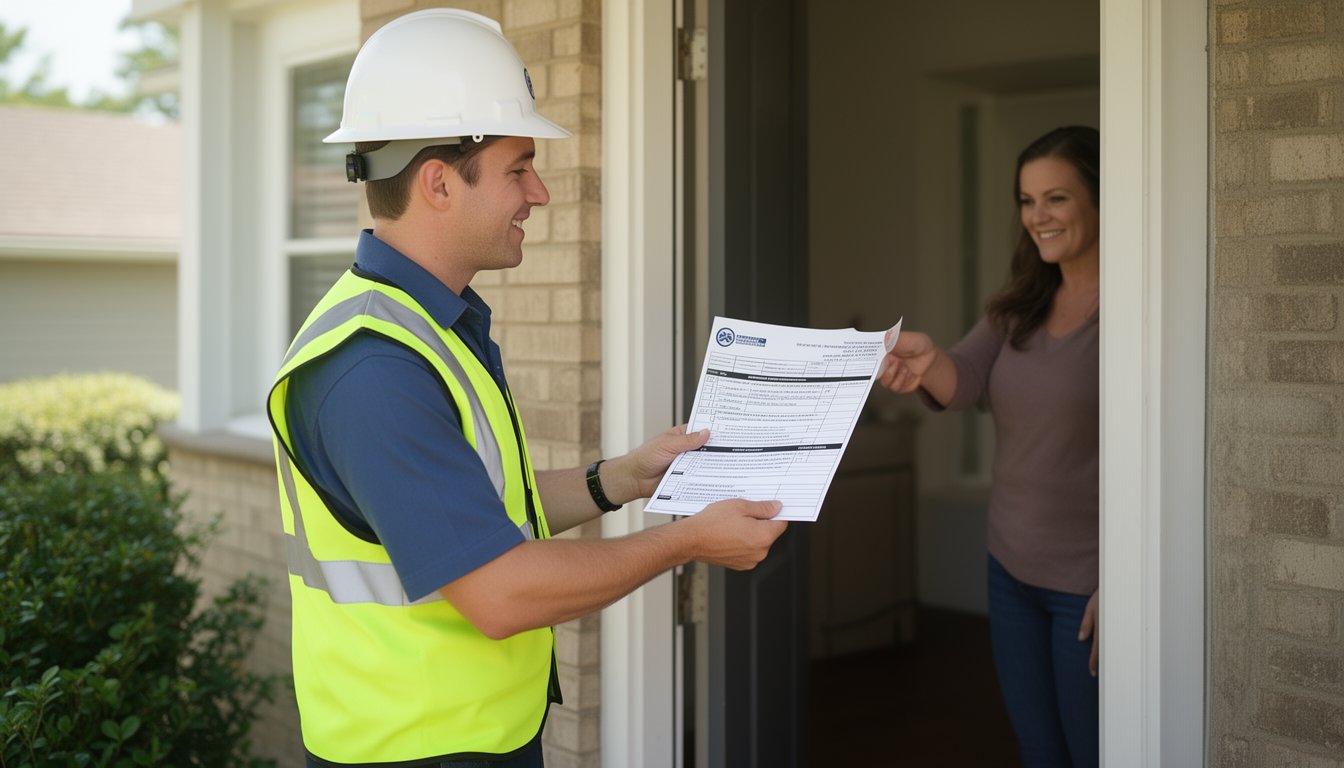
    Building inspections generate enormous paperwork. Electrical permits, plumbing inspections, structural reviews, final sign-offs—each requires documentation protecting both the homeowner and the city. Inspectors need to document findings immediately and provide proof to homeowners on the spot.

    Custom carbonless forms printing accomplishes this efficiently. The inspector completes the form once. One copy goes to the homeowner as proof. One copy goes to city records. One copy may go to the contractor. Color-coded carbonless forms printing helps departments identify which copy belongs where at a glance.

    Generic forms fail here because municipalities have different requirements, different field names, and different routing needs. Building code standards require specific inspection procedures and documentation that generic forms cannot address. Custom carbonless forms printing—printed with your city’s logo, specific inspection categories, and required signatures—tells property owners your city takes the process seriously.

    Baldwin has designed custom carbonless forms printing for municipalities across the region that matches how departments actually work. No generic templates. No missing fields. Carbonless forms printing designed for your process, printed on reliable paper, delivered on schedule.


    Record-Keeping Compliance and Carbonless Forms Printing

    Compliance is non-negotiable in government. Agencies must maintain records for years or decades. Electronic storage systems fail. Hard drives crash. Data gets lost in migrations. Paper documents stored properly last indefinitely.

    From field to back office carbonless tracks the data

    Carbonless forms printing creates immediate paper backups for every transaction. Utility companies collecting meter readings have physical records surviving any data loss. Police departments issuing citations have documentation standing up in court. School districts processing enrollment forms have records available if questions arise years later.

    Paper and digital systems work together. Carbonless forms printing provides the physical documentation agencies need for legal protection, while digital systems provide searchability and reporting modern operations require. How carbonless paper works is simple but effective: pressure-sensitive microcapsules on the top sheet burst when you write, reacting with clay on the sheet beneath to create instant duplicates.

    Baldwin delivers custom carbonless forms printing with paper quality that remains legible decades later. Our printing standards ensure forms can be scanned reliably if your agency adopts document imaging. Custom carbonless forms printing fits your process, whether capturing information on-site or consolidating it in an office.


    Industries Beyond Government Rely on Carbonless Forms Printing

    While focused on government, carbonless forms printing serves sectors where paper outperforms electronic solutions. Fire departments use carbonless citation forms because field conditions prohibit tablets. Healthcare providers use intake forms because not all patients—especially elderly patients—want electronic systems in waiting rooms. Schools use disciplinary reports because staff need quick copies without computer access.

    Transportation companies, field service operations, and utility companies rely on carbonless forms printing because it solves a fundamental problem: immediate, physical documentation matters more than convenience. When work happens in fields, vehicles, job sites, weather, and locations without reliable electricity or internet, carbonless forms printing is the most reliable solution available.

    Baldwin applies the same principle across sectors: understand your operation, design custom carbonless forms printing matching your process, deliver reliable products on quality paper, and provide service earning your trust.


    How Baldwin Delivers Custom Carbonless Forms Printing

    Custom carbonless forms printing requires understanding, not just printing. Baldwin brings 45 years serving government agencies with expert carbonless forms printing solutions. We know the difference between forms looking professional and custom carbonless forms printing actually working in your operation.

    We start by asking: “How do you actually use this form?” We listen to how your department works. We identify where copies go. We design color coding helping staff recognize which copy belongs where. We ensure carbonless forms printing matches your legal requirements and process flow.

    Then we deliver. On time. On budget. On quality paper lasting decades. Choosing Baldwin for custom carbonless forms printing means choosing a print broker with deep government expertise—not a generic printing company. We understand inspections, compliance, and field operations. We understand you can’t call a supplier when you’re in the field with a homeowner waiting for documentation.


    Ready to Upgrade Your Carbonless Forms Printing?

    Carbonless forms printing remains essential for government operations because it solves problems technology doesn’t address: immediate field documentation, reliable paper trails, professional appearance, and compliance-ready records. Electronic solutions have value in some contexts, but they can’t replace the reliability and simplicity of well-designed custom carbonless forms printing.

    Baldwin brings 45 years designing and printing custom carbonless forms printing for municipalities, government agencies, and organizations depending on reliable documentation. We understand your operation. We design custom carbonless forms printing matching your process. We deliver professional products on quality paper.

    If your agency uses generic forms or struggles with carbonless forms printing not quite fitting your needs, contact Baldwin today. Request a consultation with our forms specialist. We’ll listen to how you work, understand your requirements, and design custom carbonless forms printing making your operation more efficient and professional.

    Phone: 631-676-7335
    Email: rich@baldwinbusiness.net
    Address: 2805 Veterans Memorial Hwy., Suite 1, Ronkonkoma, NY 11779